Seattle's only interactive Pinball Museum Unlimited play in a family-friendly setting
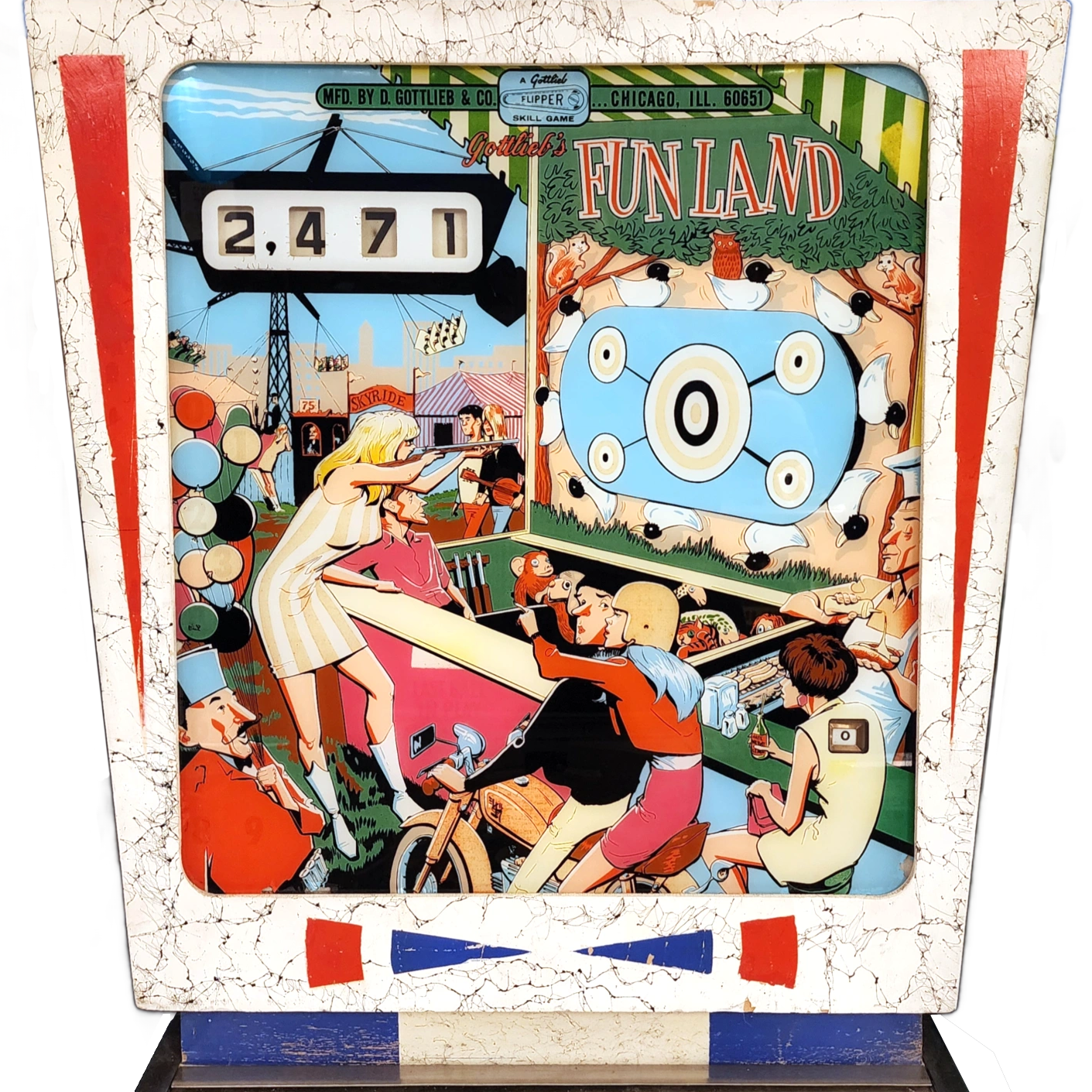
Fun Land
Date of Manufacture: 1968
Number Produced: ~3,100 units
Manufacturer: D. Gottlieb & Co.
Creators:
- Game Design: Ed Krynski
- Mechanics: Ed Krynski
- Artist: Art Stenholm
Game Type:
- Electro-mechanical,
- 1-player game
Rating: 8/10
Fun Rating: 9/10
Other Versions
Fun Land shares thematic and gameplay similarities with Fun Park, another pinball machine by Gottlieb released in the same year, aimed at arcades that needed slightly different aesthetics to suit varying themes.
DISCUSSION OF Fun Land PINBALL
History of Fun Land
The Fun Land pinball machine, released in 1968, was manufactured by Gottlieb, a company known for its expertise in designing electro-mechanical pinball machines during the golden age of pinball. Designed by Wayne Neyens, one of the most prolific pinball designers of his time, and with art by Roy Parker, the machine was part of Gottlieb's iconic wedgehead series. Fun Land captured the whimsical essence of a carnival or amusement park, resonating with players through its colorful art and engaging playfield features.
This machine stood out for its layout, which focused on skillful shooting and strategic play. The central feature was its rotating target system, which rewarded players for precision. Its artwork, rich in detail, captured the playful and chaotic atmosphere of a carnival, a theme that drew in younger players while maintaining appeal for seasoned enthusiasts. As one of the popular games of the late 1960s, Fun Land is remembered as a classic example of the transition period between electro-mechanical and solid-state pinball design.
Cultural Impact and Popularity
Cultural Impact and Popularity
Cultural Impact and Popularity
The Fun Land pinball machine captured the playful excitement of mid-20th-century carnival games. Its design leaned into the charm of nostalgic themes, making it a hit in arcades and family entertainment centers. The gameplay, focused on spinner targets and point scoring, provided an accessible yet challenging experience for players. Its colorful carnival artwork appealed to a wide audience, contributing to its popularity.
Cultural Impact and Popularity
Cultural Impact and Popularity
Innovatively, Fun Land was part of Gottlieb’s broader push to integrate more dynamic mechanical features, such as animated spinners, which rewarded players with higher scores based on timing and skill. These design choices reflected Gottlieb’s reputation for quality and creativity in the pinball world during the 1960s. These innovations, while seemingly standard now, were part of a broader movement in the late 1960s where pinball games sought to attract players through creative, skill-oriented designs.
Innovations and Features
Interesting Facts and Trivia
Interesting Facts and Trivia
- Skill-Based Gameplay with a Spinning Target: One of the game's standout features was its central spinning target. This was a mechanical element designed to reward precise shots while providing dynamic gameplay. Players needed to carefully aim their shots to hit the target and collect points, adding an element of skill that encouraged repeated play.
- Rollovers and Step-Up Advances: The game utilized rollover switches that contributed to its "A-B-C" lane completion mechanism. Successfully navigating these lanes advanced the player's score and introduced strategic planning to gameplay—a hallmark of Krynski's design philosophy.
- Theme-Driven Aesthetic: The carnival theme of Fun Land was a notable innovation in how it integrated artwork with gameplay elements. The vibrant artwork by Roy Parker captured the festive atmosphere of a funfair, resonating strongly with players and making the game visually engaging.
- Interactive Bonus Features: The implementation of bonus features tied to skillful play was another innovative aspect. Completing certain objectives triggered higher-scoring opportunities, keeping players engaged by rewarding proficiency and persistence.
- Mechanical Simplicity with Depth: Despite its mechanical simplicity compared to later solid-state machines, Fun Land showcased how electro-mechanical designs could offer depth and challenge. This balance of straightforward rules with engaging mechanics helped set a standard for pinball during the late 1960s.
Interesting Facts and Trivia
Interesting Facts and Trivia
Interesting Facts and Trivia
- Electromechanical Nature: Fun Land was part of the last generation of purely electromechanical pinball machines before solid-state technology began to dominate.
- Spinner Feature: The dual spinners were central to the scoring system, and skillful hits could result in significant point boosts.
- Art Style: Art Stenholm’s vibrant carnival-themed art became a hallmark of the machine, perfectly complementing the gameplay.
- Simplicity: Unlike modern pinball machines, Fun Land kept its rules straightforward, ensuring that beginners could enjoy the game while skilled players aimed for higher scores.
- Crossover Appeal: Its similarities to Fun Park allowed operators to cater to different aesthetic preferences without significant gameplay changes.
Fun Land Gameplay Tutorial
Goal and Objectives
The main goal in Fun Land is to score as many points as possible by hitting the dual spinners, lighting bonus features, and strategically aiming for high-value targets. The game challenges players to combine skillful shooting with a keen sense of timing to maximize their score.
Game Features and Modes
Fun Land is a single-player, electromechanical pinball machine. Its gameplay revolves around these key features:
Spinner Targets
- Two spinners in the center of the playfield are the primary scoring mechanism.
- Hitting the spinners increases the score and can unlock higher-value scoring opportunities.
Bumper Play
- Pop bumpers on the playfield add incremental points and can redirect the ball toward the spinners or side targets.
Side Targets
- These targets can be used to light additional scoring opportunities or extend bonus features.
Bonus Collection
- Completing certain target combinations lights the bonus mechanism, adding end-of-ball scoring.
How to Score High
Maximize Spinner Hits
- Focus on consistently hitting the spinners. A well-timed hit not only racks up immediate points but can also activate bonus scoring features.
Strategic Use of Bumpers
- Use the pop bumpers to keep the ball active in high-scoring zones. Lit bumpers provide better point rewards.
Aim for Side Targets
- Hit the side targets to extend play or increase scoring multipliers. This is especially useful for long-term scoring boosts.
Ball Control
- Avoid losing balls down the side lanes by carefully nudging the machine (within tilt limits) to direct the ball back into play.
Gameplay Tips
- Ball Control: Maintaining control of the ball is crucial for maximizing your score. Focus on keeping the ball away from the outlanes and in the center of the playfield.
- Timing and Precision: Pay attention to the timing of your shots. Precise flipper control can help you hit high-value targets and complete objectives.
- Understanding the Playfield: Familiarize yourself with the playfield layout, including the locations of bumpers, kickers, and rollovers. Knowing where to aim can help you optimize your gameplay strategy.
Resources
"Fun Land." International Pinball Database, www.ipdb.org. Accessed 2 Dec. 2024.
"Fun Land/Fun Park Pinball Machines." Kineticist, www.kineticist.com. Accessed 2 Dec. 2024.
"Museum of the Game - Arcade and Pinball History." www.Arcade-Museum.com. Accessed 2 Dec. 2024.
Internet Pinball Machine Database. “Fun Land.” IPDB.org. Accessed December 20, 2024. https://www.ipdb.org/machine.cgi?id=954.
PinRepair. “Gottlieb Electro-Mechanical Pinball Games.” PinRepair.com. Accessed December 20, 2024. https://www.pinrepair.com/.
Shalhoub, Michael. The Pinball Compendium: 1930s–1960s. Schiffer Publishing, 2004.
This website uses cookies.
We use cookies to analyze website traffic and optimize your website experience. By accepting our use of cookies, your data will be aggregated with all other user data.